Engineering Problem
The objective was to develop and evaluate a longitudinal aircraft pitch-control system using a documented Boeing 747 small-perturbation model, while progressively adding controller sophistication and physical realism.
Model & Method
- Reconstructed the four-state longitudinal plant using u, w, q, θ and validated the state-space model against documented numerical data.
- Characterized the open-loop short-period and phugoid modes before developing P, PI, filtered PID, LQR, and LQI controllers.
- Introduced a first-order elevator actuator, travel limits, and a 37°/s rate limit.
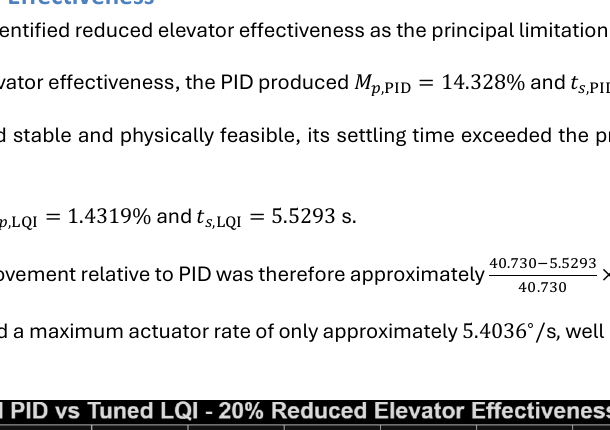
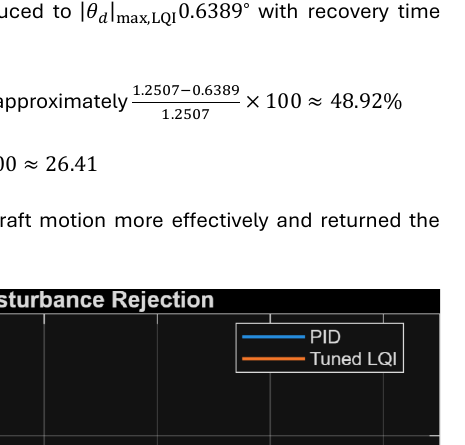
- Tested nominal tracking, disturbance rejection, reduced elevator effectiveness, combined model uncertainty, and final frozen-configuration consistency.
Final Controller Comparison
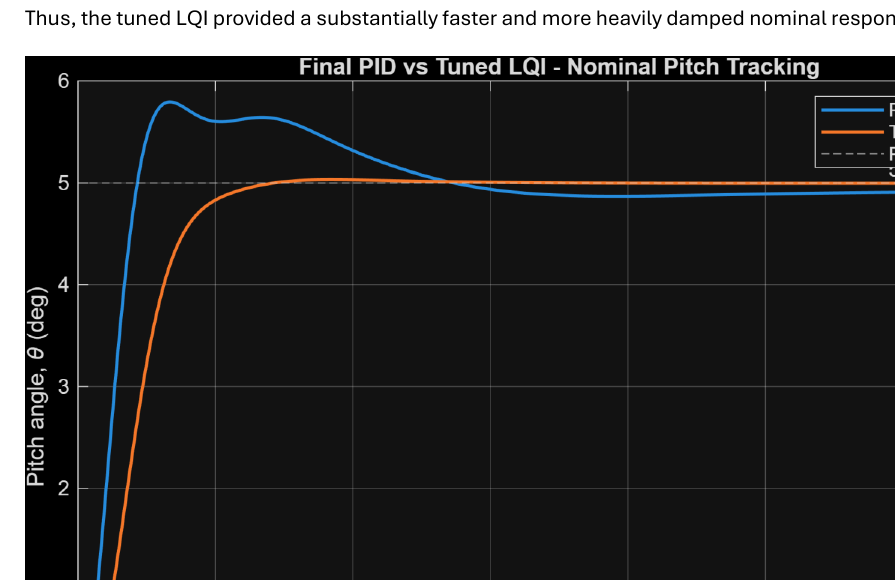
The tuned LQI reduced nominal overshoot by about 96%, settling time by about 79%, and peak actuator-rate demand by about 86% relative to the actuator-aware PID, while maintaining the same actuator constraints.
Robustness & Disturbance Testing
Engineering Takeaway
The main lesson was that model realism changed the controller-selection decision. A controller that looked satisfactory with an ideal actuator had to be redesigned once physical rate limits were introduced, and nominal performance alone was insufficient to judge robustness.
Full technical report
The complete report includes model reconstruction, open-loop dynamics, classical control, actuator-constrained simulation, robustness studies, LQR/LQI development, and final multi-case validation.